


Vimo-CreativeCut
Night2Night PM Services
Vimo-CreativeCut is the kind of entertainment app that invites quick experimentation. I opened it expecting a simple way to play with video ideas, and its main appeal became clear almost immediately: it lowers the barrier between having a rough thought and turning that thought into something shareable. The experience feels aimed at people who want to edit without making video production their entire hobby.
It is developed by Night2Night PM Services and is available free of charge for users aged Everyone. The app belongs in the creative entertainment space rather than the professional editing world, which is an important distinction. I would recommend it to someone who wants to make short personal clips, casual social content, or small visual projects without starting with a complicated desktop timeline.
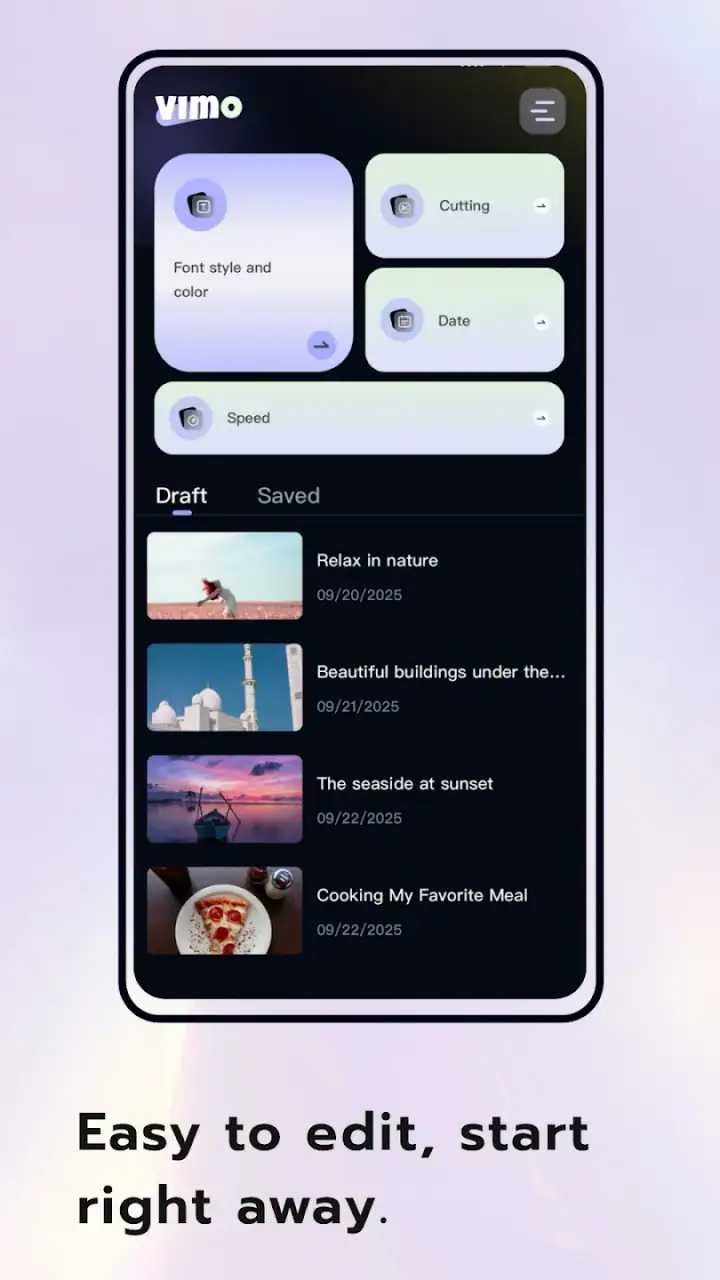
The first impression is helped by the straightforward identity of the app. Vimo-CreativeCut does not ask me to think like an editor before I begin. That matters when I am working from a phone, especially if I have only a few minutes and a clear idea in mind. Its store summary presents it as a way to unlock creativity through effortless editing, and in practical use the strongest part of that promise is the invitation to start quickly rather than study a manual first.
What makes the first week appealing
During the first few sessions, the app’s value comes from reducing hesitation. I can approach a clip as a small creative task instead of a major project: choose the material, shape the moment, make a few decisions, and see whether the result feels worth keeping. That workflow is more approachable than opening a full desktop editor with numerous panels, tracks, and technical controls competing for attention.
This makes it useful for everyday situations. Imagine recording a handful of clips during a family outing, a cooking attempt, or a walk through a new neighborhood. I might not want a polished documentary; I simply want to remove the dull beginning, keep the best visual moment, and give the sequence a little rhythm. A mobile editor such as this is most convincing when it helps me finish that modest job before the footage becomes forgotten in my camera roll.
Related News

Why WhatsApp Messenger Still Makes Everyday Communication Feel Easy

Jurassic World: The Game Is the Better Dino Tycoon for Strategic Players

Threads in Real Life: Who Should Join, Lurk, or Leave

How SHEIN Turned Shopping Into an Endless Content Feed

How to Make Fortnite Feel Smarter on Mobile

Should You Switch to Microsoft Outlook on Mobile?
Another early strength is the sense of low commitment. Because the app is free, trying it does not require a purchase decision before I know whether its editing approach suits me. That is especially helpful for occasional creators who may edit only when a particular event gives them a reason. The Everyone content rating also makes it easier to consider for general household use, although an adult should still guide younger users around sharing personal media online.
I would not confuse the first-week ease with unlimited creative control. People who already work comfortably with advanced editors may find the experience less satisfying if they expect detailed manipulation, elaborate audio work, or a highly controlled production pipeline. Vimo-CreativeCut makes more sense as a quick creative companion than as a replacement for every serious editing tool.
One practical tip is to begin with a clear purpose instead of importing everything. I get better results when I decide whether a clip is meant to be a short memory, a message for friends, or a simple social post before editing. That decision limits unnecessary tinkering and keeps the app’s quick workflow working in my favor. Importing a large collection without a plan can turn an easy session into a sorting chore.
Gallery
Useful habits for casual creators
I also found that short projects are the best way to judge the app fairly. A small sequence reveals whether the controls feel natural, whether the result has the pace I want, and whether I enjoy returning to the editor. Starting with a long event recording creates too many decisions at once and can make any mobile editor feel more demanding than it really is.
A second helpful habit is to keep an untouched copy of important footage before experimenting. This is not a criticism unique to Vimo-CreativeCut; it is simply sensible mobile editing practice. Creative apps are more enjoyable when I can try an idea without worrying that a failed cut will affect the original memory. For irreplaceable clips, I prefer to organize the source material first and treat the edited version as a separate outcome.
The app is also a good fit for people who learn by doing. Instead of reading about editing theory, I can test a shorter opening, change the order of moments, and compare the emotional effect. That trial-and-error process is where a lightweight app earns its place. It gives beginners a practical way to discover that pacing often matters more than adding every available visual treatment.
At the same time, beginners should not expect the app to make every creative decision for them. Even an effortless editor cannot decide which moment is meaningful, what should be removed, or whether a clip feels too long for the intended viewer. The software can simplify execution, but the user still needs a basic sense of selection and timing.
Whether it keeps earning attention after the novelty
The more important question is what happens after the first burst of experimentation. Many creative apps are enjoyable for a few days because new tools encourage playful tests, then become unused once the novelty fades. Vimo-CreativeCut has a better chance of staying useful when I attach it to recurring moments rather than treating it as a one-time toy.
For me, the strongest recurring use is quick personal storytelling. I can turn scattered phone footage into a compact record of an outing, a project, or a small milestone. The result does not need to be elaborate. A repeatable routine—select the strongest moments, remove pauses, check the flow, and save the finished version—creates more lasting value than constantly searching for a spectacular effect.
It can also suit people who communicate visually but do not want to maintain a complicated production setup. A small business owner, student, hobbyist, or community organizer may occasionally need a short video and prefer to handle it on a phone. In those cases, the app’s value comes from being available at the moment an idea appears. The less preparation required, the more likely I am to complete the project instead of postponing it.
That said, recurring value depends on the type of work. If I need a consistent brand system, detailed caption control, precise audio mixing, or a repeatable professional template process, I would look toward a more specialized alternative. A full desktop editor offers deeper control, while established social platforms may be more convenient when the entire goal is to publish immediately inside one network. Vimo-CreativeCut sits between those choices: more focused on making a standalone edit than a basic camera tool, but less suitable for demanding production management.
Its current version is 1.0.3, and the app was released on September 26, 2025. That relatively early stage affects how I assess long-term commitment. I like the directness of a new creative tool, but lasting value will depend on whether the editing experience remains dependable and whether future development continues to make everyday work smoother. I would not choose it solely because it is new; I would keep it installed only if it becomes part of a real routine.
The existing reception gives the app a reasonable starting point. It holds an average rating of 4.1 from 786 ratings, with 216 written reviews, and has passed 500K installs. Those figures suggest that the app has attracted meaningful attention, but they do not replace personal testing. A creative workflow is subjective: an interface that feels refreshingly simple to one person may feel restrictive to another.
The maintenance cost is mostly creative, not technical
For occasional use, the maintenance burden feels modest because the app is free and does not require me to build a large editing system around it. The real upkeep is organizational. If I leave clips scattered across the phone, forget why I saved them, or keep too many unfinished drafts, the app cannot solve that clutter. A small naming or folder habit outside the editor can make future sessions much faster.
I recommend deciding where finished videos belong before beginning a project. Keeping personal memories, drafts, and ready-to-share versions conceptually separate prevents the common problem of opening an old edit and wondering whether it is complete. This is a non-obvious advantage of a simple workflow: when there are fewer production stages, a clear personal routine matters more than elaborate project management.
Another maintenance consideration is consistency. If I use an app only once every few months, I may need a short refresher each time, especially if I have forgotten where a particular control sits. Regular small projects are easier because the sequence becomes familiar. Someone who wants a tool that can be mastered once and then left untouched may prefer a more established editor with a workflow they already know.
Storage and sharing habits matter too. Edited video can quickly occupy space, so I would avoid keeping every failed experiment indefinitely. After reviewing a finished result, I would retain the source footage that matters, keep the final version, and remove redundant exports when appropriate. This makes the app more sustainable on a phone and prevents the creative process from becoming another source of digital clutter.
The minimum operating system is Android 7.0, which gives the app a broad compatibility range for Android users. That is useful for people who do not own a recent phone, although compatibility alone does not guarantee that every device will feel equally comfortable during editing. Older hardware may make any video workflow feel less responsive, so I would test a short project first rather than committing a large collection of footage immediately.
Where fatigue can appear
The first source of fatigue is repetition. Quick editing is pleasant when I am making one small project, but the same streamlined approach can feel limiting when I have many similar clips to process. If every video requires the same manual choices and there is little room to establish a personal system, the convenience may wear thin for frequent creators.
A second source is the gap between “easy” and “finished.” Removing obvious mistakes is simple; creating a video with a deliberate mood, balanced sound, and strong progression takes judgment. Users may enjoy the initial simplicity and then feel frustrated when their results still need careful refinement. That is not necessarily a flaw, but it means the app is best approached as a tool that shortens the mechanical work, not one that replaces creative editing skill.
I would also be cautious about choosing it for projects where precision is the main requirement. If a video must match exact timing, preserve a complex sequence of layers, or follow a strict production specification, I would rather use a tool designed around detailed control. Vimo-CreativeCut is more convincing when speed and approachability matter more than exhaustive adjustment.
There is a social fatigue to consider as well. If my goal is simply to publish inside a particular platform, editing separately can add one more step to the process. A platform’s built-in editor may be faster for a spontaneous post, while Vimo-CreativeCut becomes more worthwhile when I want a finished file I can reuse or share in more than one place.
For younger users, the Everyone rating makes the app broadly accessible, but accessibility should not be mistaken for automatic privacy awareness. A child may understand how to make a clip without understanding the consequences of sharing faces, locations, or private conversations. I would treat the app as suitable for family creativity with sensible supervision around the content that leaves the device.
One trade-off I noticed is that a lightweight creative environment can encourage speed at the expense of reflection. I may finish a clip quickly and share it before watching it from beginning to end. My best practice is to review the complete result once without touching the controls. That final uninterrupted watch often reveals awkward pauses or a weak ending that is easy to miss while editing.
Who should use it, and who should skip it
I would point Vimo-CreativeCut toward a beginner who wants a friendly starting point, an occasional creator who does not want to learn a large editing suite, or anyone who regularly turns phone footage into small personal stories. It is also a sensible option for someone who values a free entry point and wants to test whether mobile editing can become a habit before investing time in a more advanced workflow.
I would steer a professional editor, a creator managing a demanding publishing schedule, or a user who needs highly controlled production toward a deeper alternative. The same simplicity that makes this app approachable may become a constraint when projects require repeatable technical precision. It is not the right choice merely because the project happens to involve video.
It is worth asking one practical question before installing: do I need to make occasional, manageable edits, or am I looking for a complete production workstation? If the answer is the former, the app has a clear role. If the answer is the latter, starting here may create a second migration later when the workflow outgrows it.
Another question is whether I will actually return to it. The best test is not how entertaining the first experiment feels, but whether I already have a recurring use case: weekly clips, monthly memories, short updates, or a regular hobby project. Without that reason, the app may become another unused icon after the initial curiosity passes.
My long-term verdict
After looking beyond the first impression, I see Vimo-CreativeCut as a promising lightweight creative app rather than an all-purpose video studio. Its lasting appeal comes from making small edits feel achievable and from supporting a practical phone-first habit. The free price lowers the risk of trying it, and the broad age rating makes it approachable for general entertainment and family-oriented creative use.
Its limitations are equally important. Users who need advanced control, highly repeatable professional workflows, or immediate publishing inside a social network may be happier elsewhere. Even casual creators need to supply their own organization, judgment, and review discipline. The app can reduce friction, but it cannot create a meaningful story from indifferent footage on its own.
My recommendation is to install it with a specific first project rather than browsing aimlessly. Make one short edit from a small group of clips, watch the result all the way through, and ask whether the process felt easy enough to repeat. If it turns an otherwise forgotten collection of phone videos into finished memories, it has earned a permanent place. If the controls feel too limited after that test, moving to a more advanced editor will be a clearer choice than forcing this one to do work it was not built to handle.
In the end, the real strength of Vimo-CreativeCut is repeatable simplicity. I would keep it for quick, personal projects and recommend it to friends who want to start editing without a steep learning curve. I would not recommend it as the final destination for serious video production. Its future value will be measured less by the excitement of the first session and more by whether it continues to help ordinary users finish small creative ideas month after month.
FAQs for Vimo-CreativeCut
What is Vimo-CreativeCut and what does it do?
Vimo-CreativeCut is a versatile video editing app designed for both Android and iOS devices. It allows users to create professional-quality videos with ease, using a variety of tools and effects. The app supports features like trimming, merging, adding music, and special effects, making it perfect for both beginners and experienced video editors.
Is Vimo-CreativeCut free to use, or does it require a subscription?
Vimo-CreativeCut offers a free version with basic features, allowing users to try out the app without any cost. However, for access to advanced features and tools, users may need to purchase a subscription or make in-app purchases. This model ensures flexibility for those who need more powerful editing capabilities.
Can I use Vimo-CreativeCut to edit videos on both Android and iOS devices?
Yes, Vimo-CreativeCut is available for both Android and iOS platforms. This cross-platform availability means you can edit your videos on various devices without losing progress. The app provides a consistent experience across different devices, making it convenient for users who switch between operating systems.
What are some key features of Vimo-CreativeCut that set it apart from other video editing apps?
Vimo-CreativeCut stands out due to its user-friendly interface, extensive library of effects, and advanced editing tools. Features like motion tracking, animated stickers, and customizable text options provide a creative edge. Additionally, its ability to export videos in high resolution ensures that your projects maintain quality across different platforms.
Does Vimo-CreativeCut support social media integration for easy sharing?
Yes, Vimo-CreativeCut offers seamless integration with popular social media platforms, allowing users to directly share their edited videos. This feature simplifies the process of uploading content to sites like Instagram, YouTube, and Facebook, making it ideal for content creators looking to expand their online presence quickly and efficiently.
Pros
- User-friendly interface for easy navigation.
- Wide range of editing tools available.
- Supports high-quality video exports.
- Regular updates with new features.
- Offers creative templates for quick edits.
Cons
- Some features require in-app purchases.
- Occasional lag on older devices.
- Limited music library options.
- Ads can be intrusive during editing.
- No offline editing capabilities.


